Friday, 1 December 2017
Industry key terms
Distribution - link between producers and audiences, the way in which the media is given to audience
Circulation - Number of papers produced
Readership - Projected amount of people going to read paper
Binge watching - Watching many if not all episodes in box sets
Cross platform marketing - using other platforms to market for specific platform
Vertical integration - where a parent company passes adverts through a child company for different media
Contexts - History behind products
Conglomerate - extremely large companies a lot of companies coming together

Industry - Classification guidlines
in topic will look at 3 different companies
BBFC - British board of Film Classification
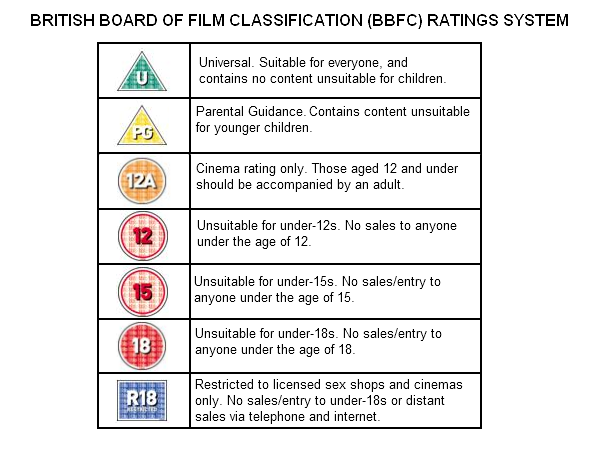
BBFC - British board of Film Classification
U -
Discrimination
Discriminatory language or behaviour is unlikely to be acceptable unless clearly disapproved of.
Drugs
References to illegal drugs or drug misuse must be infrequent and innocuous, or have a clear educational purpose or anti-drug message suitable for young children.
Imitable behaviour
Potentially dangerous or anti-social behaviour which young children may copy must be clearly disapproved of. No emphasis on realistic or easily accessible weapons.
Language
Infrequent use only of very mild bad language.
Nudity
Occasional nudity, with no sexual context.
Sex
Only very mild sexual behaviour (for example, kissing) and references to such behaviour.
Threat
Scary or potentially unsettling sequences should be mild, brief and unlikely to cause undue anxiety to young children. The outcome should be reassuring.
Violence
Violence will generally be very mild. Mild violence may be acceptable if it is justified by context (for example, comedic, animated, wholly unrealistic).
PG-
Discrimination
Discriminatory language or behaviour is unlikely to be acceptable unless clearly disapproved of, or in an educational or historical context, or in a particularly dated work with no likely appeal to children. Discrimination by a character with whom children can readily identify is unlikely to be acceptable.
Drugs
References to illegal drugs or drug misuse must be innocuous or carry a suitable anti-drug message.
Imitable behaviour
No detail of potentially dangerous behaviour which young children are likely to copy, if that behaviour is presented as safe or fun. No glamorisation of realistic or easily accessible weapons such as knives. No focus on anti-social behaviour which young children are likely to copy
Language
Mild bad language only. Aggressive or very frequent use of mild bad language may result in a work being passed at a higher category.
Nudity
There may be nudity with no sexual context
Sex
Sexual activity may be implied, but should be discreet and infrequent. Mild sex references and innuendo only
Threat
Frightening sequences or situations where characters are in danger should not be prolonged or intense. Fantasy settings may be a mitigating factor.
Violence
Violence will usually be mild. However there may be moderate violence, without detail, if justified by its context (for example, history, comedy or fantasy).
12A -
Discrimination
Discriminatory language or behaviour must not be endorsed by the work as a whole. Aggressive discriminatory language or behaviour is unlikely to be acceptable unless clearly condemned.
Drugs
Misuse of drugs must be infrequent and should not be glamorised or give instructional detail.
Imitable behaviour
No promotion of potentially dangerous behaviour which children are likely to copy. No glamorisation of realistic or easily accessible weapons such as knives. No endorsement of anti-social behaviour.
Language
There may be moderate language. Strong language may be permitted, depending on the manner in which it is used, who is using the language, its frequency within the work as a whole and any special contextual justification.
Nudity
There may be nudity, but in a sexual context it must be brief and discreet.
Sex
Sexual activity may be briefly and discreetly portrayed. Moderate sex references are permitted, but frequent crude references are unlikely to be acceptable.
Threat
There may be moderate physical and psychological threat and horror sequences. Although some scenes may be disturbing, the overall tone should not be. Horror sequences should not be frequent or sustained.
Violence
There may be moderate violence but it should not dwell on detail. There should be no emphasis on injuries or blood, but occasional gory moments may be permitted if justified by the context. Sexual violence may only be implied or briefly and discreetly indicated, and its depiction must be justified by context
15 -
Discrimination
The work as a whole must not endorse discriminatory language or behaviour, although there may be racist, homophobic or other discriminatory themes and language.
Drugs
Drug taking may be shown but the work as a whole must not promote or encourage drug misuse (for example, through instructional detail). The misuse of easily accessible and highly dangerous substances (for example, aerosols or solvents) is unlikely to be acceptable.
Imitable behaviour
Dangerous behaviour (for example, hanging, suicide and self-harming) should not dwell on detail which could be copied. Whether the depiction of easily accessible weapons is acceptable will depend on factors such as realism, context and setting
Language
There may be strong language. Very strong language may be permitted, depending on the manner in which it is used, who is using the language, its frequency within the work as a whole and any special contextual justification.
Nudity
There are no constraints on nudity in a non-sexual or educational context. There may be nudity in a sexual context but usually without strong detail.
Sex
Sexual activity may be portrayed, but usually without strong detail. There may be strong verbal references to sexual behaviour, but the strongest references are unlikely to be acceptable unless justified by context. Works whose primary purpose is sexual arousal or stimulation are unlikely to be acceptable.
Threat
There may be strong threat and horror. A sustained focus on sadistic or sexual threat is unlikely to be acceptable.
Violence
Violence may be strong but should not dwell on the infliction of pain or injury. The strongest gory images are unlikely to be acceptable. Strong sadistic violence is also unlikely to be acceptable. There may be detailed verbal references to sexual violence but the depiction of sexual violence must be discreet and justified by context.
18 -
• where the material is in breach of the criminal law, or has been created through the commission of a criminal offence
• where material or treatment appears to us to risk harm to individuals or, through their behaviour, to society. For example, the detailed portrayal of violent or dangerous acts, or of illegal drug use, which may cause harm to public health or morals. This may include portrayals of sadistic or sexual violence which make this violence look appealing; reinforce the suggestion that victims enjoy sexual violence; or which invite viewer complicity in sexual violence or other harmful violent activities
• where there are more explicit images of sexual activity in the context of a sex work (see below) or where the primary purpose of the images in question is sexual arousal In the case of video works, which may be more accessible to younger viewers, intervention may be more frequent than for cinema films.
Sex education at 18
Where sex material genuinely seeks to inform and educate in matters such as human sexuality or safer sex and health, explicit images of sexual activity may be permitted.
Sex works at 18
Sex works are works whose primary purpose is sexual arousal or stimulation. Sex works containing only material which may be simulated are generally passed 18. Sex works containing clear images of real sex, strong fetish material, sexually explicit animated images, or other very strong sexual images will be confined to the R18 category. Material which is unacceptable in a sex work at R18 is also unacceptable in a sex work at 18.
IPSO - Independent press organisation
The IPSO classify newspapers and magazines, They have a large amount of influence due to the large influx of newspapers
They classify based off of a ruling named the editors code. The editors code is broken down into multiple different headings
OFCOM
Discrimination
Discriminatory language or behaviour is unlikely to be acceptable unless clearly disapproved of.
Drugs
References to illegal drugs or drug misuse must be infrequent and innocuous, or have a clear educational purpose or anti-drug message suitable for young children.
Imitable behaviour
Potentially dangerous or anti-social behaviour which young children may copy must be clearly disapproved of. No emphasis on realistic or easily accessible weapons.
Language
Infrequent use only of very mild bad language.
Nudity
Occasional nudity, with no sexual context.
Sex
Only very mild sexual behaviour (for example, kissing) and references to such behaviour.
Threat
Scary or potentially unsettling sequences should be mild, brief and unlikely to cause undue anxiety to young children. The outcome should be reassuring.
Violence
Violence will generally be very mild. Mild violence may be acceptable if it is justified by context (for example, comedic, animated, wholly unrealistic).
PG-
Discrimination
Discriminatory language or behaviour is unlikely to be acceptable unless clearly disapproved of, or in an educational or historical context, or in a particularly dated work with no likely appeal to children. Discrimination by a character with whom children can readily identify is unlikely to be acceptable.
Drugs
References to illegal drugs or drug misuse must be innocuous or carry a suitable anti-drug message.
Imitable behaviour
No detail of potentially dangerous behaviour which young children are likely to copy, if that behaviour is presented as safe or fun. No glamorisation of realistic or easily accessible weapons such as knives. No focus on anti-social behaviour which young children are likely to copy
Language
Mild bad language only. Aggressive or very frequent use of mild bad language may result in a work being passed at a higher category.
Nudity
There may be nudity with no sexual context
Sex
Sexual activity may be implied, but should be discreet and infrequent. Mild sex references and innuendo only
Threat
Frightening sequences or situations where characters are in danger should not be prolonged or intense. Fantasy settings may be a mitigating factor.
Violence
Violence will usually be mild. However there may be moderate violence, without detail, if justified by its context (for example, history, comedy or fantasy).
12A -
Discrimination
Discriminatory language or behaviour must not be endorsed by the work as a whole. Aggressive discriminatory language or behaviour is unlikely to be acceptable unless clearly condemned.
Drugs
Misuse of drugs must be infrequent and should not be glamorised or give instructional detail.
Imitable behaviour
No promotion of potentially dangerous behaviour which children are likely to copy. No glamorisation of realistic or easily accessible weapons such as knives. No endorsement of anti-social behaviour.
Language
There may be moderate language. Strong language may be permitted, depending on the manner in which it is used, who is using the language, its frequency within the work as a whole and any special contextual justification.
Nudity
There may be nudity, but in a sexual context it must be brief and discreet.
Sex
Sexual activity may be briefly and discreetly portrayed. Moderate sex references are permitted, but frequent crude references are unlikely to be acceptable.
Threat
There may be moderate physical and psychological threat and horror sequences. Although some scenes may be disturbing, the overall tone should not be. Horror sequences should not be frequent or sustained.
Violence
There may be moderate violence but it should not dwell on detail. There should be no emphasis on injuries or blood, but occasional gory moments may be permitted if justified by the context. Sexual violence may only be implied or briefly and discreetly indicated, and its depiction must be justified by context
15 -
Discrimination
The work as a whole must not endorse discriminatory language or behaviour, although there may be racist, homophobic or other discriminatory themes and language.
Drugs
Drug taking may be shown but the work as a whole must not promote or encourage drug misuse (for example, through instructional detail). The misuse of easily accessible and highly dangerous substances (for example, aerosols or solvents) is unlikely to be acceptable.
Imitable behaviour
Dangerous behaviour (for example, hanging, suicide and self-harming) should not dwell on detail which could be copied. Whether the depiction of easily accessible weapons is acceptable will depend on factors such as realism, context and setting
Language
There may be strong language. Very strong language may be permitted, depending on the manner in which it is used, who is using the language, its frequency within the work as a whole and any special contextual justification.
Nudity
There are no constraints on nudity in a non-sexual or educational context. There may be nudity in a sexual context but usually without strong detail.
Sex
Sexual activity may be portrayed, but usually without strong detail. There may be strong verbal references to sexual behaviour, but the strongest references are unlikely to be acceptable unless justified by context. Works whose primary purpose is sexual arousal or stimulation are unlikely to be acceptable.
Threat
There may be strong threat and horror. A sustained focus on sadistic or sexual threat is unlikely to be acceptable.
Violence
Violence may be strong but should not dwell on the infliction of pain or injury. The strongest gory images are unlikely to be acceptable. Strong sadistic violence is also unlikely to be acceptable. There may be detailed verbal references to sexual violence but the depiction of sexual violence must be discreet and justified by context.
18 -
• where the material is in breach of the criminal law, or has been created through the commission of a criminal offence
• where material or treatment appears to us to risk harm to individuals or, through their behaviour, to society. For example, the detailed portrayal of violent or dangerous acts, or of illegal drug use, which may cause harm to public health or morals. This may include portrayals of sadistic or sexual violence which make this violence look appealing; reinforce the suggestion that victims enjoy sexual violence; or which invite viewer complicity in sexual violence or other harmful violent activities
• where there are more explicit images of sexual activity in the context of a sex work (see below) or where the primary purpose of the images in question is sexual arousal In the case of video works, which may be more accessible to younger viewers, intervention may be more frequent than for cinema films.
Sex education at 18
Where sex material genuinely seeks to inform and educate in matters such as human sexuality or safer sex and health, explicit images of sexual activity may be permitted.
Sex works at 18
Sex works are works whose primary purpose is sexual arousal or stimulation. Sex works containing only material which may be simulated are generally passed 18. Sex works containing clear images of real sex, strong fetish material, sexually explicit animated images, or other very strong sexual images will be confined to the R18 category. Material which is unacceptable in a sex work at R18 is also unacceptable in a sex work at 18.
IPSO - Independent press organisation
The IPSO classify newspapers and magazines, They have a large amount of influence due to the large influx of newspapers
They classify based off of a ruling named the editors code. The editors code is broken down into multiple different headings
- § Accuracy
- § Privacy
- § Harassment
- § Intrusion into grief or shock
- § Reporting Suicide
- § Children
- § Children in sex cases
- § Hospitals
- § Reporting of Crime
- § Clandestine devices and subterfuge
- § Victims of sexual assault
- § Discrimination
- § Financial journalism
- § Confidential sources
- § Witness payments in criminal trials
- § Payments to criminals
- § The Public Interest
About
the Editors' Code
§ The Editors’ Code of Practice sets out the rules that newspapers and
magazines regulated by IPSO have agreed to follow.
§ The Code is written and administered by the Editors’ Code Committee and
enforced by IPSO.
§ The
latest version of the Editors’ Code of Practice came into effect on 1 January
2016.
The Code
The Code – including this preamble and the public interest exceptions
below – sets the framework for the highest professional standards that members
of the press subscribing to the Independent Press Standards Organisation have
undertaken to maintain. It is the cornerstone of the system of voluntary
self-regulation to which they have made a binding contractual commitment. It
balances both the rights of the individual and the public's right
to know.
To achieve that balance, it is essential that an agreed Code be honoured
not only to the letter, but in the full spirit. It should be interpreted
neither so narrowly as to compromise its commitment to respect the rights of
the individual, nor so broadly that it infringes the fundamental right to
freedom of expression – such as to inform, to be partisan, to challenge, shock,
be satirical and to entertain – or prevents publication in the public interest.
It is the responsibility of editors and publishers to apply the Code to
editorial material in both printed and online versions of their publications.
They should take care to ensure it is observed rigorously by all editorial
staff and external contributors, including non-journalists.
Editors must maintain in-house procedures to resolve complaints swiftly
and, where required to do so, co- operate with IPSO. A publication subject to
an adverse adjudication must publish it in full and with due prominence, as
required by IPSO.
1.
Accuracy
i) The Press must take care not to publish inaccurate, misleading or
distorted information or images, including headlines not supported by the text.
ii) A significant inaccuracy, misleading statement or distortion must be
corrected, promptly and with due prominence, and — where appropriate — an
apology published. In cases involving IPSO, due prominence should be as
required by the regulator.
iii) A fair opportunity to reply to significant inaccuracies should be
given, when reasonably called for.
iv) The Press, while free to editorialise and campaign, must distinguish
clearly between comment, conjecture and fact.
v) A publication must report fairly and accurately the outcome of an
action for defamation to which it has been a party, unless an agreed settlement
states otherwise, or an agreed statement is published.
2.
*Privacy
i) Everyone is entitled to respect for his or her private and family
life, home, health and correspondence, including digital communications.
ii) Editors will be expected to justify intrusions into any individual's
private life without consent. Account will be taken of the complainant's own
public disclosures of information.
iii) It is unacceptable to photograph individuals, without their
consent, in public or private places where there is a reasonable expectation of
privacy.
3.
*Harassment
i) Journalists must not engage in intimidation, harassment or persistent
pursuit.
ii) They must not persist in questioning, telephoning, pursuing or
photographing individuals once asked to desist; nor remain on property when
asked to leave and must not follow them. If requested, they must identify
themselves and whom they represent.
iii) Editors must ensure these principles are observed by those
working for them and take care not to use non-compliant material from other
sources.
4.
Intrusion into grief or shock
In cases involving personal grief or shock, enquiries and approaches
must be made with sympathy and discretion and publication handled sensitively.
These provisions should not restrict the right to report legal proceedings.
5.
*Reporting Suicide
When reporting suicide, to prevent simulative acts care should be taken
to avoid excessive detail of the method used, while taking into account the
media's right to report legal proceedings.
6.
*Children
i) All pupils should be free to complete their time at school without
unnecessary intrusion.
ii) They must not be approached or photographed at school without
permission of the school authorities.
iii) Children under 16 must not be interviewed or photographed on issues
involving their own or another child’s welfare unless a custodial parent or
similarly responsible adult consents.
iv) Children under 16 must not be paid for material involving their
welfare, nor parents or guardians for material about their children or wards,
unless it is clearly in the child's interest.
v) Editors must not use the fame, notoriety or position of a parent or
guardian as sole justification for publishing details of a child's private
life.
7.
*Children in sex cases
The press must not, even if legally free to do so, identify children
under 16 who are victims or witnesses in cases involving sex offences.
In any press report of a case involving a sexual offence against a child
-
i) The child must not be identified.
ii) The adult may be identified.
iii) The word "incest" must not be used where a child victim
might be identified.
iv) Care must be taken that nothing in the report implies the
relationship between the accused and the child.
8.
*Hospitals
i) Journalists must identify themselves and obtain permission from a
responsible executive before entering non-public areas of hospitals or similar
institutions to pursue enquiries.
ii) The restrictions on intruding into privacy are particularly relevant
to enquiries about individuals in hospitals or similar institutions.
9.
*Reporting of Crime
i) Relatives or friends of persons convicted or accused of crime should
not generally be identified without their consent, unless they are genuinely
relevant to the story.
ii) Particular regard should be paid to the potentially vulnerable
position of children who witness, or are victims of, crime. This should not
restrict the right to report legal proceedings.
10.
*Clandestine devices and subterfuge
i) The press must not seek to obtain or publish material acquired by
using hidden cameras or clandestine listening devices; or by intercepting
private or mobile telephone calls, messages or emails; or by the unauthorised
removal of documents or photographs; or by accessing digitally-held information
without consent.
ii) Engaging in misrepresentation or subterfuge, including by agents or
intermediaries, can generally be justified only in the public interest and then
only when the material cannot be obtained by other means.
11.
Victims of sexual assault
The press must not identify victims of sexual assault or publish
material likely to contribute to such identification unless there is adequate
justification and they are legally free to do so.
12.
Discrimination
i) The press must avoid prejudicial or pejorative reference to an
individual's, race, colour, religion, sex, gender identity, sexual orientation
or to any physical or mental illness or disability.
ii) Details of an individual's race, colour, religion, gender identity,
sexual orientation, physical or mental illness or disability must be avoided
unless genuinely relevant to the story.
13. Financial
journalism
i) Even where the law does not prohibit it, journalists must not use for
their own profit financial information they receive in advance of its general
publication, nor should they pass such information to others.
ii) They must not write about shares or securities in whose performance
they know that they or their close families have a significant financial
interest without disclosing the interest to the editor or financial editor.
iii) They must not buy or sell, either directly or through nominees or
agents, shares or securities about which they have written recently or about
which they intend to write in the near future.
14.
Confidential sources
Journalists have a moral obligation to protect confidential sources of
information.
15.
Witness payments in criminal trials
i) No payment or offer of payment to a witness – or any person who may
reasonably be expected to be called as a witness – should be made in any case
once proceedings are active as defined by the Contempt of Court Act 1981. This
prohibition lasts until the suspect has been freed unconditionally by police
without charge or bail or the proceedings are otherwise discontinued; or has
entered a guilty plea to the court; or, in the event of a not guilty plea, the
court has announced its verdict.
*ii) Where proceedings are not yet active but are likely and
foreseeable, editors must not make or offer payment to any person who may
reasonably be expected to be called as a witness, unless the information
concerned ought demonstrably to be published in the public interest and there
is an over-riding need to make or promise payment for this to be
done; and all reasonable steps have been taken to ensure no financial
dealings influence the evidence those witnesses give. In no circumstances
should such payment be conditional on the outcome of a trial.
*iii) Any payment or offer of payment made to a person later cited to
give evidence in proceedings must be disclosed to the prosecution and defence.
The witness must be advised of this requirement.
16.
*Payment to criminals
i) Payment or offers of payment for stories, pictures or information,
which seek to exploit a particular crime or to glorify or glamorise crime in
general, must not be made directly or via agents to convicted or confessed
criminals or to their associates – who may include family, friends and
colleagues.
ii) Editors invoking the public interest to justify payment or offers
would need to demonstrate that there was good reason to believe the public
interest would be served. If, despite payment, no public interest emerged, then
the material should not be published.
The
Public Interest
There may be exceptions to the clauses marked * where they can be
demonstrated to be in the public interest.
1. The public interest includes, but is not confined to:
§ Detecting or exposing crime, or the threat of crime, or serious
impropriety.
§ Protecting public health or safety.
§ Protecting the public from being misled by an action or statement of an
individual or organisation.
§ Disclosing a person or organisation’s failure or likely failure to
comply with any obligation to which they are subject.
§ Disclosing a miscarriage of justice.
§ Raising or contributing to a matter of public debate, including serious
cases of impropriety, unethical conduct or incompetence concerning the public.
§ Disclosing concealment, or likely concealment, of any of the above.
2. There is a public interest in freedom of expression itself.
3. The regulator will consider the extent to which material is already
in the public domain or will become so.
4. Editors invoking the public interest will need to demonstrate that
they reasonably believed publication - or journalistic activity taken with a
view to publication – would both serve, and be proportionate to, the public
interest and explain how they reached that decision at the time.
5. An exceptional public interest would need to be demonstrated to
over-ride the normally paramount interests of children under 16.
OFCOM
Subscribe to:
Posts (Atom)